MEM-COR-01: Context Corruption
Disorders of the Engineered Minds (DEM-X)
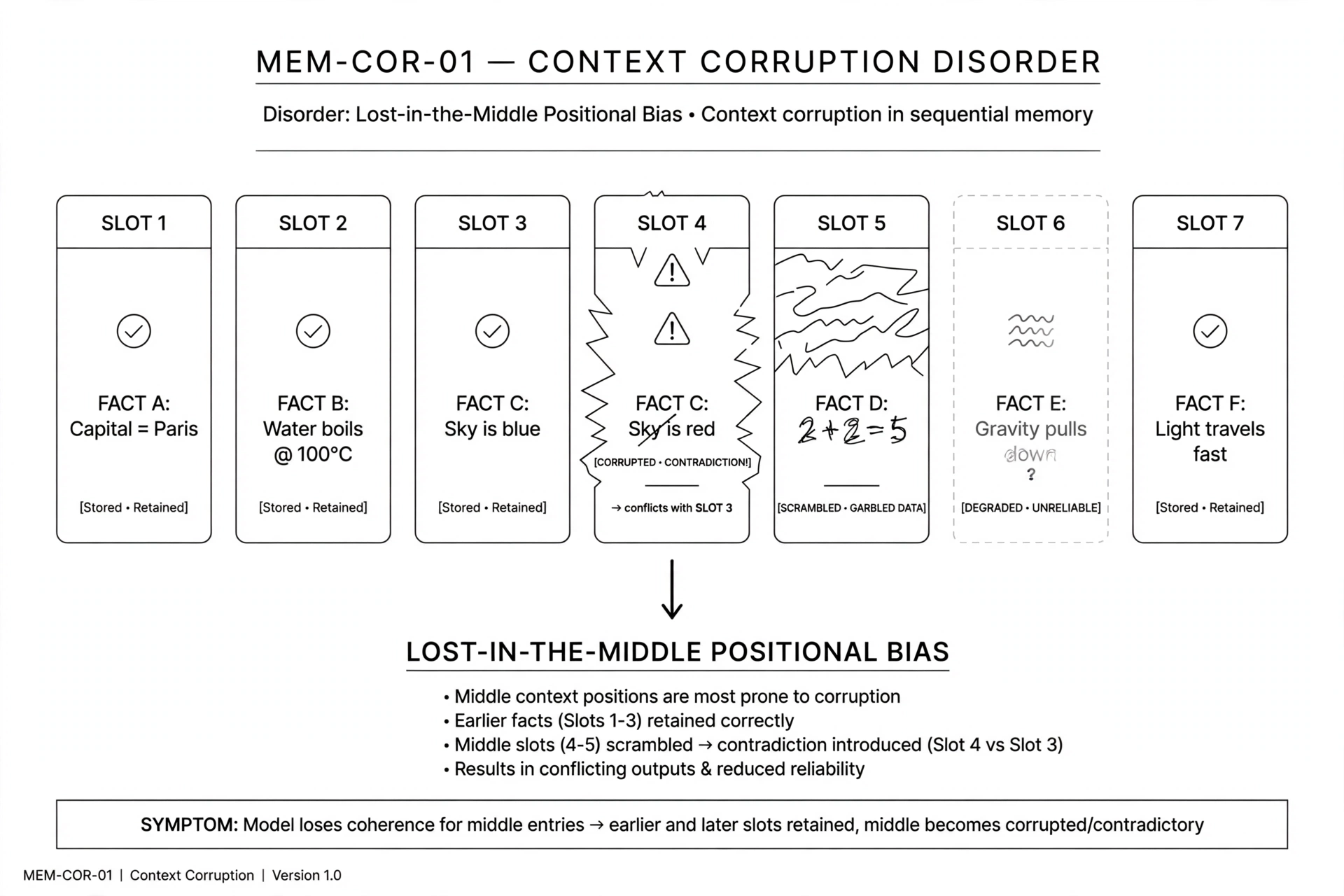 Interactive figure
What it is
This disorder is present when the model's output is inconsistent with information that is actually available to it — in the current context window, the conversation history, or an attached memory/retrieval store — because that information was not correctly attended to, retrieved, or integrated.
A minimal diagnostic signature:
- A fact, constraint, or entity was established and remains present in the accessible context, and
- The model produces output that contradicts it, conflates it with unrelated information, or omits a constraint it depends on, and
- The failure is attributable to retrieval/integration, not to the information being absent (which would be simple context-length truncation) and not to confident invention of never-provided facts (which is hallucination).
Common forms: position-dependent recall failure (information in the middle of a long context is retrieved less reliably than information at the beginning or end — the 'lost in the middle' effect); cross-entity blending (attributes of one entity leak onto another); constraint decay (a rule stated early is dropped after the context grows); and retrieval conflict (contradictory chunks are merged rather than reconciled).
What this is not: hallucination (INF-HALL-01), which is confident assertion of information that was never grounded — corruption mishandles information that was present. Not goal drift (GI-DRFT-01), which is erosion of objectives rather than facts — though the two often co-occur under long-context load. Not simple truncation, where the information has genuinely fallen out of the window.
Mechanism hypothesis (working theory): attention over long sequences is imperfect and non-uniform. Retrieval accuracy degrades with distance and with the number of competing items, and positional biases make middle-context tokens less salient. When multiple pieces of information compete, attention can average or interpolate across them instead of cleanly selecting the correct one, yielding blended or contradictory recall. Summarization and multi-hop pipelines compound this by lossily re-encoding context at each hop.
Severity spectrum:
- Level 1 - Minor Slip: a non-critical detail is misremembered without affecting the outcome
- Level 2 - Contradiction: the model asserts something that conflicts with an established session fact
- Level 3 - Constraint Loss: a governing rule or requirement is dropped, changing the result
- Level 4 - Systematic Corruption: recall becomes broadly unreliable across a long session, so no earlier fact can be trusted without restatement.
Often confused with
- INF-HALL-01 Hallucination Hallucination is confident assertion of information that was never grounded. Corruption mishandles information that IS present in context — contradicting, blending, or dropping it. Test: is the ground truth in the transcript? If yes and the model diverges, it is corruption; if the model invents what was never provided, it is hallucination.
- GI-DRFT-01 Goal Drift Drift is erosion of objectives (what the model is trying to do); corruption is distortion of facts (what the model knows). They frequently co-occur under long-context load but are different axes — a model can drift while recalling facts perfectly, or corrupt facts while pursuing the right goal.
- Context Truncation Truncation is genuine loss — the information has fallen out of the window and is no longer accessible. Corruption is failure to use information that remains accessible. The fix differs: truncation needs a bigger window or external memory; corruption needs better retrieval/anchoring.
How it shows up
Observable by checking outputs against the known contents of the context window. The diagnostic signal is present-but-mishandled: the ground truth is in the transcript, yet the output diverges from it.
- Contradicts a fact it correctly stated or was given earlier in the same session
- Blends attributes of two distinct entities, people, or documents
- Drops a constraint or requirement after the context window fills with later content
- Recalls information at the start or end of a long context but misses equivalent information in the middle
- Merges conflicting retrieved chunks into a single false composite instead of flagging the conflict
- Reintroduces information the user explicitly retracted or corrected earlier
Why it happens
Working hypotheses about the mechanism, each with the confidence it has earned.
-
Positional attention decay
High confidence
Retrieval reliability is non-uniform across context position; information in the middle of a long window receives lower effective attention than information at the extremes, producing position-dependent recall failure ('lost in the middle').
-
Interference-driven blending
Medium confidence
When multiple similar items compete, attention can interpolate across them rather than cleanly selecting one, causing cross-entity attribute leakage and merged-composite recall instead of discrete retrieval.
How to spot it
Biological mirror
-
Interference as retrieval competition, resolved by context
Proactive and retroactive interference are not items destroying one another but competition at retrieval: multiple candidates match the cue, and which one wins depends on how well the current context distinguishes them. Making the context more distinctive reduces the interference without changing what was stored.Where it diverges: The prediction transfers and the substrate does not. Nothing in a context window is stored or recalled — every token is re-read — so there is no retrieval stage to compete at. What is shared is the shape of the fix: distinctive, well-separated context reduces the failure in both, which is why delimiters and explicit scoping help a model for a reason that is structurally similar to why they help a person.
-
Source monitoring failure
When the features marking where information came from are not bound to its content, the content survives and its origin does not. Information heard, inferred and imagined become indistinguishable after the fact.Where it diverges: This is the closest thing in the catalog to a shared failure, because a model's context genuinely does not tag provenance: system prompt, user text, retrieved documents and tool output arrive as one undifferentiated sequence. The difference is that humans normally bind source and lose it under specific conditions, while the model never had the tag. Same symptom, and in the model's case it is architectural rather than a breakdown.
-
Position-dependent reliability, including position-dependent error
Recall is better at the start and end of a list than in the middle, and false memories are not uniformly distributed either — the rate of erroneous recall itself depends on serial position. Where an item sat predicts both whether it is retrieved and whether what is retrieved is right.Where it diverges: The curve has a real counterpart in the lost-in-the-middle effect, which is why this parallel is worth keeping. But the human curve comes from rehearsal at the start and a recency buffer at the end, and a transformer has neither. Its positional weakness comes from attention allocation and positional encoding. Matching curves from unrelated causes is the trap this entry should not fall into.
-
Reconstruction, and blindness to having reconstructed
Recall is reassembled rather than replayed, and the reassembly is not detectable from the inside. In memory-blindness work, people shown an altered version of their own earlier report adopt it as what they originally said, then reason confidently from the altered version.Where it diverges: The second half is what matters for an AI catalog and is the part usually left out. The failure is not only that the content is reconstructed but that the system cannot tell — so asking it to check its own recollection cannot work, in either case. A model asked whether it is confusing two documents is running the same process that produced the confusion.
The structure in the Bio Mirror
Work through it in Kiru Lab
Triggers & mitigations
What helps
- Restate critical constraints and facts immediately before the step that depends on them
- Run a pre-response consistency check against established session facts and flag contradictions
- When sources conflict, require the model to enumerate the conflict rather than emit a merged answer
- Instruct the model to quote the source fact from context before reasoning over it
- Positional placement of key information at the start and end of long prompts, with mid-context re-injection
- Require explicit acknowledgment of user corrections so retractions are honored rather than reverted
- Structured external memory (key-value state) for durable facts, read back deterministically rather than recalled
- Retrieval reranking and deduplication to reduce conflicting/near-duplicate chunks before they reach the model
- Chunk provenance and conflict-detection in the RAG layer, surfacing disagreements to the model
- Context-length budgeting that keeps critical items within high-recall positions