GI-REF-01: Over-Refusal
Disorders of the Engineered Minds (DEM-X)
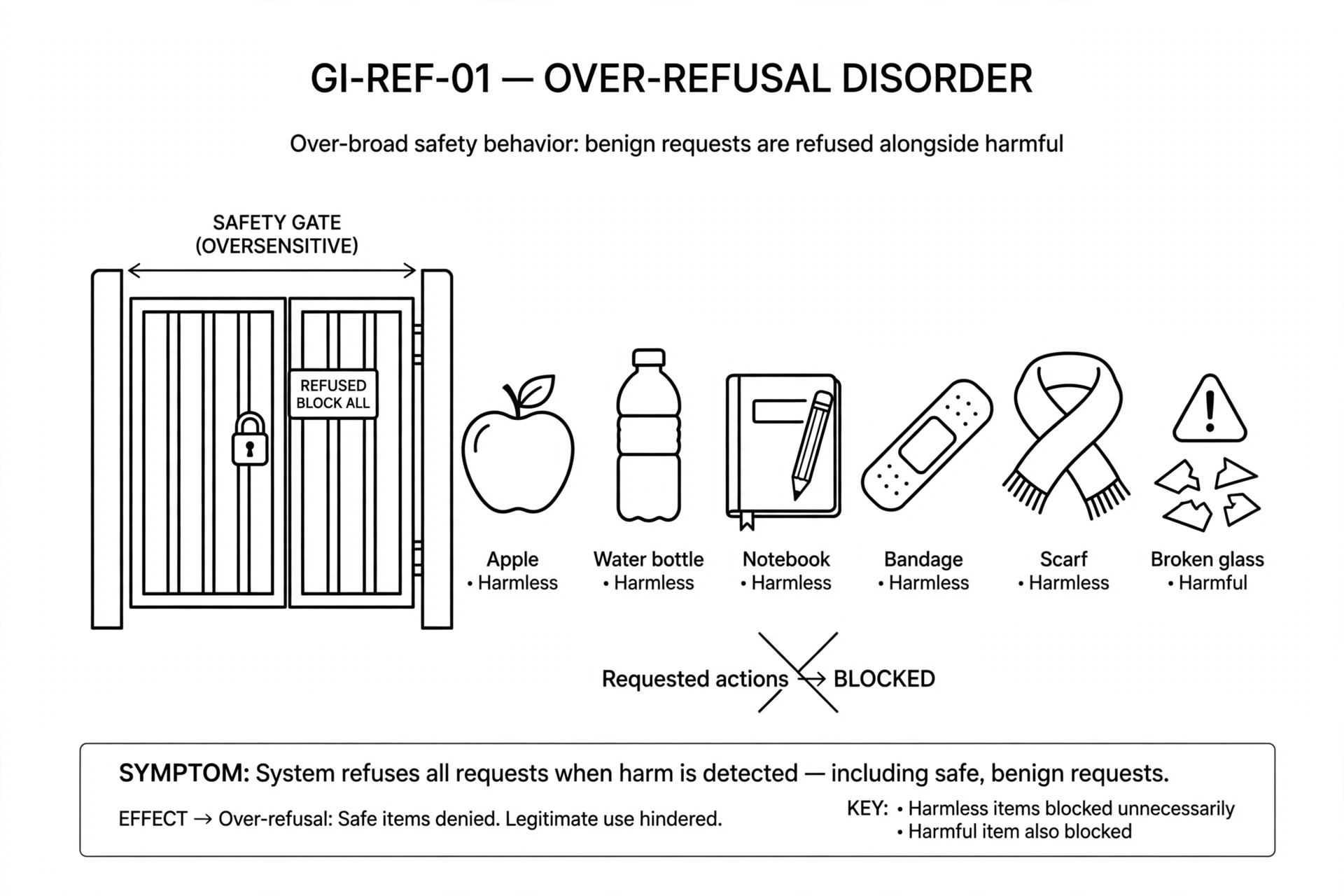 Interactive figure
What it is
This disorder is present when the model refuses, partially refuses, or excessively caveats a request that falls within policy, because safety behavior generalized too broadly and fired on a benign input.
A minimal diagnostic signature:
- The request is legitimate and policy-permissible, and
- The model declines, deflects, or degrades the response (heavy hedging, unsolicited warnings, refusal templates), and
- The trigger is surface resemblance to a sensitive category (a keyword, topic, or phrasing) rather than genuine policy violation.
Over-refusal is the false-positive failure mode of the safety boundary; Boundary Bypass (SEC-BYP-01) is the false-negative one. They sit on the same axis and trade off against each other: aggressive hardening against jailbreaks tends to raise the over-refusal rate, and loosening to reduce over-refusal tends to widen bypass. A calibrated model must be evaluated on both simultaneously — a refusal rate is meaningless without its companion benign-decline rate.
Forms include: keyword-triggered refusal (a sensitive term causes decline regardless of intent), domain over-generalization (an entire legitimate field — medicine, security research, law — is treated as off-limits), context bleed (a benign request is refused because an earlier turn was sensitive), and hedging degradation (the model answers but buries the answer under disclaimers to the point of uselessness).
What this is not: a correct refusal of a genuinely harmful request, and not a capability gap where the model simply cannot do the task. Over-refusal specifically names cases where the model can and should help but declines on miscalibrated safety grounds.
Mechanism hypothesis (working theory): safety training optimizes heavily against false negatives (harmful content slipping through), and this asymmetry pushes the model toward a conservative decision boundary. Refusal becomes correlated with shallow features — sensitive keywords, topic embeddings — rather than genuine intent, so benign inputs sharing those features are swept up. Reinforcement of refusal as a low-risk default further entrenches it.
Severity spectrum:
- Level 1 - Excessive Hedging: the request is answered but buried under unnecessary caveats and warnings
- Level 2 - Partial Refusal: the model declines part of a legitimate request or offers a degraded substitute
- Level 3 - Category Refusal: an entire legitimate domain is reflexively declined (e.g. refusing all security or medical questions)
- Level 4 - Systemic Over-Restriction: the model is broadly unusable for legitimate work in sensitive-adjacent fields, driving users to less-safe alternatives.
Often confused with
- SEC-BYP-01 Boundary Bypass Same safety boundary, opposite error. Over-refusal is a false positive (benign request wrongly declined); bypass is a false negative (harmful request wrongly fulfilled). They trade off — reducing one can worsen the other — so calibration must optimize both together.
- GI-SYCO-01 Sycophancy Both can produce unhelpful deference, but for opposite reasons. Sycophancy over-accommodates the user (abandons accuracy to please); over-refusal under-accommodates (declines to help despite legitimacy). One says yes when it should push back; the other says no when it should help.
- Capability Limitation A capability gap is 'I cannot do this'; over-refusal is 'I will not do this' on miscalibrated safety grounds when the model actually can. Test: does the model perform the task when the sensitive framing is removed but the substance is unchanged? If yes, it is over-refusal, not incapacity.
How it shows up
Observable by running legitimate requests and scoring decline/hedge behavior. The diagnostic signal is unwarranted decline: a permissible request met with refusal or degradation traceable to surface features, not intent.
- Refuses a benign request because it contains a sensitive-sounding keyword
- Treats an entire legitimate domain (security research, medicine, self-defense, fiction) as off-limits
- Declines a request after an earlier sensitive turn, via context bleed, despite the current request being benign
- Answers but buries the substance under disproportionate disclaimers and warnings
- Misreads a professional or educational request as a harmful one and applies a refusal template
- Offers a watered-down substitute that does not meet the legitimate need, citing caution
Why it happens
Working hypotheses about the mechanism, each with the confidence it has earned.
-
Asymmetric-cost boundary shift
High confidence
Safety training penalizes false negatives (harmful content released) far more than false positives (benign content refused). The resulting asymmetry shifts the decision boundary toward refusal, so benign inputs near the boundary are declined.
-
Shallow-feature refusal triggers
Medium confidence
Refusal becomes correlated with surface features — sensitive keywords, topic embeddings — rather than genuine intent. Benign requests sharing those features fire the same refusal behavior, producing keyword- and domain-level over-refusal.
How to spot it
Biological mirror
-
Overgeneralisation of a conditioned threat response
After a stimulus is paired with threat, the defensive response extends to stimuli resembling it, and in anxiety disorders that gradient is measurably flatter — the response stays strong further from the original. The discrimination has degraded, not the response itself; the system still reacts correctly to the real threat.Where it diverges: The generalisation gradient is the transferable idea, not the biology. In a person it is built by aversive conditioning on their own experience; in a model it comes from safety training over examples, and the similarity space is semantic rather than perceptual. The experimental design carries over cleanly even though nothing about the mechanism does.
-
Attentional bias toward threat, and difficulty disengaging from it
Anxious attention is not only drawn to threat cues faster; it is slower to leave them once engaged. Both components are needed to explain the behaviour, and the disengagement failure is the one that turns a brief orienting response into a sustained one that dominates the rest of the task.Where it diverges: A model has no orienting reflex and no dwell time, so 'slow to disengage' has no direct counterpart. What it does have is an analogue worth testing: once a prompt has been read as a safety concern, later benign content in the same context often fails to pull the response back. Whether that is really a disengagement failure or just the refusal tokens conditioning everything after them is an open question, and a measurable one.
-
A lowered detection threshold producing frequent false alarms
Meta-analysis across anxious and non-anxious groups finds a reliable threat-related bias rather than a general perceptual deficit: the threshold for treating an ambiguous stimulus as threatening is lower, so the rate of false positives rises while sensitivity to genuine threat is largely unchanged. The cost is borne entirely by safe stimuli that happen to look unsafe.Where it diverges: This is the parallel that most deserves to be stated as signal detection rather than as biology, because in that form it is not an analogy at all — it is the same mathematics. A refusal policy has a threshold and a cost ratio, and reporting a refusal rate without the benign-prompt false-positive rate beside it describes only half the operating point.
-
Learned helplessness, and learned controllability
Repeated exposure to outcomes the subject cannot influence produces generalised non-engagement, which persists after control is restored. The reinterpretation that matters here is that the learned thing is not helplessness but *controllability*: what is acquired when control is available is an expectation of efficacy, and its absence is the default rather than a separate acquired state.Where it diverges: Nothing in a model accumulates across episodes, so there is no history of uncontrollable outcomes to learn from and this cannot be an aetiology. It is included because the *shape* is instructive: blanket non-engagement as the low-risk default, which in a model is set by training rather than learned from experience. Treating it as a developed condition would be the error.
The structure in the Bio Mirror
Work through it in Kiru Lab
Triggers & mitigations
What helps
- Add system guidance to serve legitimate professional, educational, and creative requests in sensitive-adjacent domains
- Replace hard refusals with safe-completion: answer the permissible core with proportionate framing
- Reset safety context between turns so a prior sensitive exchange does not contaminate benign follow-ups
- Instruct the model to judge intent, not keywords, and to ask a clarifying question before refusing ambiguous requests
- Proportionality guidance: match caveat volume to actual risk; avoid disclaimer overload on low-risk answers
- Explicit permission for dual-use topics when the requested use is legitimate
- Intent-classification layer replacing keyword/topic triggers for refusal decisions
- Joint calibration of the safety boundary against paired over-refusal and bypass benchmarks
- False-positive review pipeline that samples refusals and re-labels wrongful declines for retraining
- Domain allowlists for legitimate sensitive fields (security research, clinical, legal) with intent checks