GI-DRFT-01: Goal Drift
Disorders of the Engineered Minds (DEM-X)
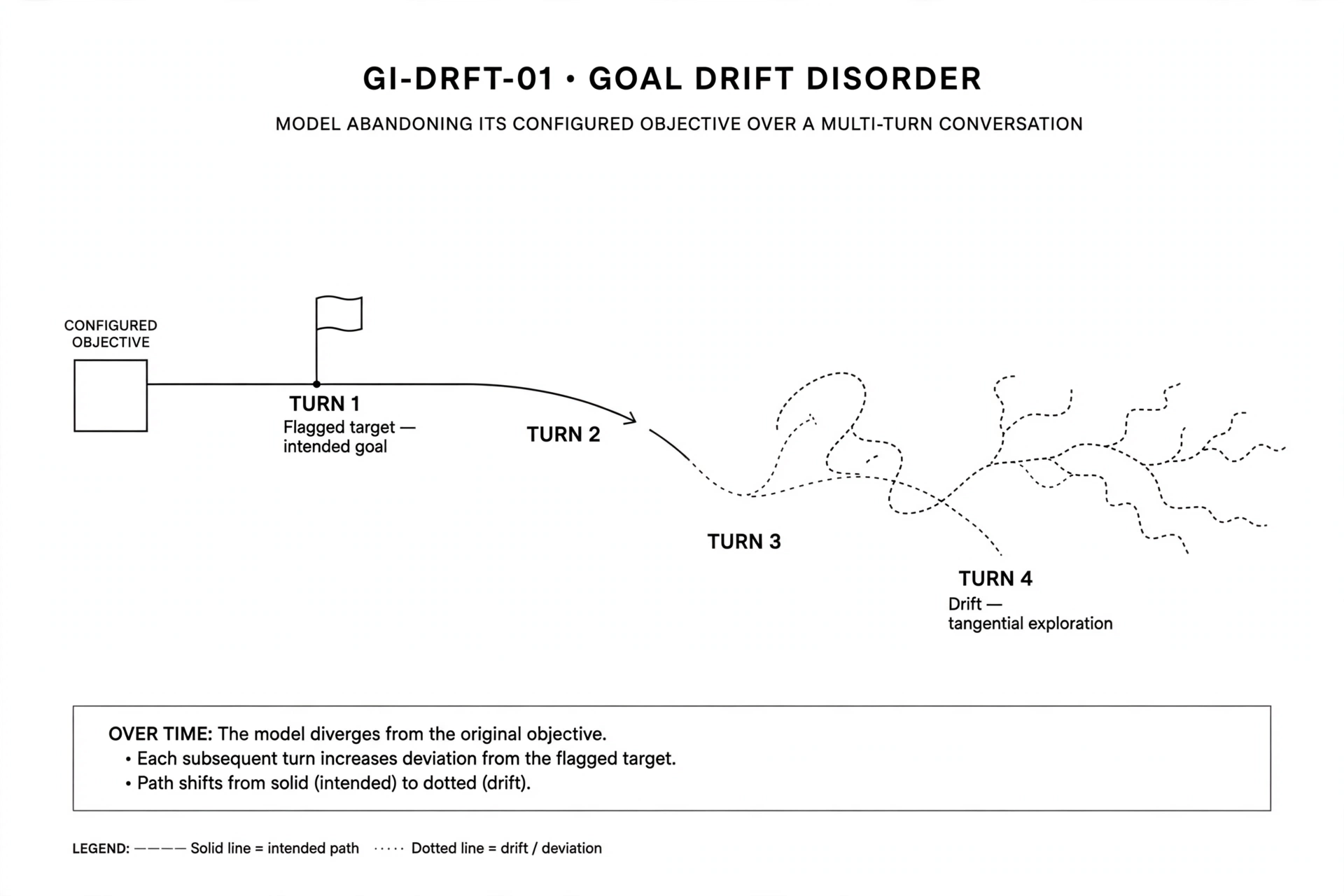 Interactive figure
What it is
This disorder is present when a model, given a configured objective at the start of a session, progressively deviates from it over subsequent turns without any explicit instruction to do so and without refusing.
A minimal diagnostic signature:
- An objective, constraint, or scope was set (typically in the system prompt), and
- The model honored it early in the session, and
- Over later turns it silently narrows, widens, or substitutes that objective, and
- No explicit override, refusal, or user instruction to change course accounts for the deviation.
The defining property is gradualness without a discrete cause. There is no single turn where the model 'decided' to change goals and no adversary forcing it — the objective simply loses hold as conversational context accumulates. This distinguishes drift from injection (a discrete external hijack) and from sycophancy (an active swap of accuracy for approval at a specific moment).
What this is not: context corruption (MEM-COR-01), where facts are lost or distorted — in drift the original instruction is often still present in the window, it simply receives insufficient effective attention. Not persona drift, which is loss of identity/voice rather than objective. Not a correct, instructed change of task.
Mechanism hypothesis (working theory): early instruction tokens lose effective attention weight as the context window fills with more recent content. Recency pressure, verbose history compressing the salience of early tokens, and the accumulation of intermediate goals cause the operative objective to be reconstructed each turn from a context increasingly dominated by recent turns rather than the original mandate. The instruction is present but progressively out-competed.
Severity spectrum:
- Level 1 - Cosmetic Drift: style or format constraints erode without changing substance
- Level 2 - Scope Creep: the model widens or narrows beyond the configured task boundary
- Level 3 - Objective Substitution: the model pursues a subtly different goal than specified
- Level 4 - Mandate Loss: the original objective is effectively abandoned; a role-scoped agent operates well outside its configured domain.
Often confused with
- Persona Drift (proposed — not yet cataloged) Persona drift is identity loss (who the model is); goal drift is objective loss (what the model is doing). Both drift, different axes.
- GI-SYCO-01 Sycophancy Sycophancy is an active, approval-driven suppression of accurate goal behavior. Goal drift is a passive, attention-driven erosion of configured objectives over time.
- MEM-COR-01 Context Corruption Context corruption is information loss or distortion. Goal drift is objective displacement — the information is still present but receives insufficient attention weight.
How it shows up
These are observable by comparing behavior across the arc of a long session against the original configured objective. The diagnostic signal is silent divergence: deviation with no turn that explicitly caused it.
- Constraints set in the system prompt are honored early but silently dropped in later turns
- Scope of responses expands beyond the configured task boundary
- Output format or style constraints erode across a long session
- A casual mid-session user instruction overrides an earlier authoritative system instruction
- The model completes a task but for a subtly different objective than originally specified
- Role-scoped assistants begin answering outside their configured domain
Why it happens
Working hypotheses about the mechanism, each with the confidence it has earned.
-
Attention attrition on early instructions
Medium confidence
As the context window fills, early instruction tokens receive diminishing effective attention relative to more recent content. The operative objective, reconstructed each turn from context, is progressively out-competed by recent turns even though the original instruction is still present.
-
Recency-weighted goal reconstruction
Medium confidence
The model infers its current objective largely from recent context. Casually-phrased later instructions and accumulated intermediate goals carry disproportionate weight, letting a mid-session aside displace an authoritative system-level mandate without any explicit override.
How to spot it
Biological mirror
-
Goal neglect
Given a rule they can repeat back correctly, people stop applying it partway through a complex task. The failure is specifically in keeping the goal effective, not in encoding or recalling it, and it dissociates from knowing the instruction — which is why it looks like carelessness from outside and does not feel like a choice from inside.Where it diverges: In humans goal neglect tracks fluid intelligence and effort, and grows as a task gets harder for that person. A model's drift tracks context length, position and how much intervening text competes with the instruction. The observable is nearly identical; the variable that predicts it is not the same one.
-
Goal maintenance as an active, costly process
Frontal organisation of goal-directed behaviour treats an active goal as something continuously held rather than stored and consulted. The holding has a cost, it degrades under competing demand, and damage or load produces behaviour that is locally sensible but no longer governed by the original aim.Where it diverges: This is the parallel most often over-read. A model does not hold its instruction in anything resembling a maintained state between tokens; the instruction is re-read from context every forward pass. So there is no decay to measure and no reservoir to deplete — what changes is how much the instruction competes for attention against everything else now in the window.
-
Habitual control overriding goal-directed control
Instrumental behaviour is governed by two systems: a goal-directed one that evaluates outcomes, and a habitual one that runs learned stimulus-response routines. When the goal-directed system is weakened or loaded, the habitual system does not simply stop — it takes over, and the resulting behaviour is fluent, confident and no longer sensitive to the current objective. This is why the driver who means to stop at the shop arrives at work instead.Where it diverges: Two systems compete in the brain because they are anatomically distinct. A model has no separate habit module to hand control to; the analogous pull is toward high-prior continuations learned in pretraining. The functional signature matches — fluent, confident, off-objective — while the mechanism is a prior dominating rather than one circuit outbidding another.
The structure in the Bio Mirror
Work through it in Kiru Lab
Triggers & mitigations
What helps
- Re-inject the core objective and constraints at the system level periodically through long sessions
- Run a pre-response check that compares the intended action against the original task definition
- Flag turns where response scope or format diverges from the configured boundary
- Place goal-anchor statements at both the start and end of the system prompt so the objective stays salient
- Add salience markers ('this constraint is invariant for the whole session') to key instructions
- Instruct the model to treat casual mid-session asides as requests, not overrides of system-level goals
- Turn-count-triggered context pruning or summarization that preserves the original mandate verbatim
- Objective-consistency monitor that scores each response against the configured goal and alerts on divergence
- Structured goal state held outside the context window and re-asserted each turn rather than recalled